Humanitarian agencies salute the work of Human Rights Defenders in Hebron on the occasion of International Human Rights Day

Jerusalem, 10 December 2015

“UNRWA teachers, social workers and mental health counsellors across the West Bank are reporting extremely high levels of stress and trauma. If no action is taken an entire generation of children and youth will be lost. Their future must be restored.”

On the occasion of Human Rights Day, the UN Coordinator for Humanitarian Aid and Development Activities, Robert Piper and a group of UN and NGO leaders visited Hebron this week to see first-hand the situation of human rights defenders in Hebron, as well as the obstacles to Palestinian children’s right to an education in a safe environment. During the visit, the delegation spent time in the Israeli-controlled areas of Hebron (H2). The delegation was briefed by organizations providing a ‘protective presence’ for Palestinians. As part of their work, these organizations monitor and document access at checkpoints and accompany children to and from schools in areas where they are subject to frequent settler harassment and violence.

James Heenan of the UN Office of the High Commissioner for Human Rights recalled that human rights defenders have the right to pursue peaceful activities to protect the rights of others, and in turn to be protected in doing so. “The fact that these very people have themselves become a target is alarming,” he said. The visit also took them to Qurtuba school, where protective presence actors accompany some 100 children through check points to and from school every day. At the school, teachers reported that students these days are unable to concentrate and show signs of psychosocial distress and that they are terrified walking through checkpoints to and from school. Felipe Sanchez, Director of UNRWA Operations West Bank, confirmed this, saying “UNRWA teachers, social workers and mental health counsellors across the West Bank are reporting extremely high levels of stress and trauma. If no action is taken an entire generation of children and youth will be lost. Their future must be restored.”

In the current wave of violence, Hebron city has had the highest number of Palestinian casualties in a single locality in the oPt, and increased movement restrictions have affected access to services and places of work throughout the city. Of particular concern is the impact of the violence and the restrictions on the access of children to school due to checkpoints. 4,200 children pass through checkpoints on their way to and from school in Hebron every day. In this context, the reliance on protective presence actors has only become more acute. During this period, obstruction by settlers and Israeli Security Forces of international organizations and local groups attempting to provide a protective presence and documenting human rights violations has also increased. Staff of these organizations have been subjected to physical attacks, arrest, threats by settlers and anonymous death threats. Three of the four organizations providing protective presence have even been obliged to temporarily pull out of H2 at times in October as a result of the threats. Since 3 November, the implementation of a closed military zone in H2 has further prevented these organizations from doing their vital work. “Human rights defenders play a vital role in promoting human rights,” said Mr. Piper after the visit. “Protective presence organizations are on the front line of this work in the occupied Palestinian territory, embodying the support of the world community to the people of Hebron and defending the rights of Palestinian children, not least to a safe journey to and from school. They must be allowed to continue their work without violence, threats or retaliation.”

For more information, please contact Ms. Hayat Abu-Saleh at abusaleh@un.org or +972 54 33 11 816.

Living in the path of settlers

There is a military watch box on the roof of the Shamsiya house, making the roof a closed military zone and the family is forbidden to access it. For security reasons the Israeli military will search the house on a regular basis. On Saturdays, there is a tour for settlers through Hebron and the settlers from the Tel Rumeida settlement walk past the Shamsiya house. They access the roof and have damaged the water tanks. They throw stones at the family below and their daughter was knocked unconscious after being hit by a rock thrown by a settler. The Israeli military do not stop the settlers from being on the roof. The family are part of the “shoot back” camera project, run by the Israeli Human Rights organisation B’tselem. Vulnerable families are given cameras to document attacks on them and their property.

In the following 9 minute film, Yuval Orr shows what the daily life is like for 15-year-old Awni Abu Shamsiya as he attempts to maintain some shred of normalcy in his hometown of Hebron.

When the ‘daily grind’ doesn’t refer to your favourite coffee joint

The bleakness of the situation here {in Hebron} is further exacerbated by the settler violence that occurs under the ‘watchful’ eye of the military that is deployed here to maintain security. In 2011, when settlers tried to burn down the Cordoba school in Hebron, the principal installed video cameras on the premises to monitor security. Read more

100 kindergarten students start school in September thanks to LFoH

Leichhardt Friends of Hebron are thrilled to announce that the Festival of Friendship, that was held on June 18, raised over $5000 for their two kindergarten projects in the South Hebron Hills. We have just received this report from APHEDA’s Middle East Project Officer, who was able to visit the kindergartens last week:

The Umm al Khair kindergarten is going well. It has 10 children and 2 teachers. There are many more children who wish to attend, however their villages are further away and their parents fear them walking on the main road the 3-4km to the kindergarten. To address this problem, the Villages Group, our partner organisation in Palestine, has sought and gained other funding to operate a minibus in the area. The minibus will transport girls to the local high school, and has agreed to collect the children for the kindergarten as well, lessening parents’ fears for their children.

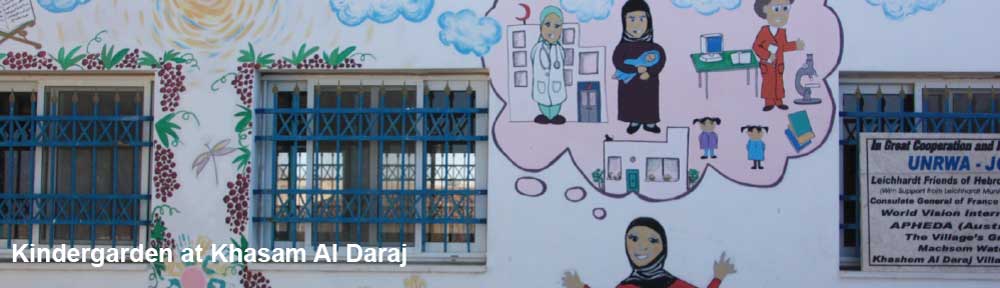
The Khashem al Daraj kindergarten is in the final stages of construction and is expected to be completed by the end of July, ready for the start of the school year in September. It is being constructed by the same builder who worked on the Um al Khair kindergarten. It is being built on land owned by the village council, so there is no concern about future claims on the land by private landholders. The village has a population of approximately 160 families (average family size is 8). The kindergarten expects an enrolment of 40 children when the school year starts in September and will have 2 teachers. Due to a harsh drought, many families have temporarily moved north out of the village in search of better pastures for their sheep and goat herds. Abu Hamza, the head of the Khashem al Daraj village council, expects an enrolment of 100 children at the kindergarten when families return from the north. The Israeli women’s organization, Machsom Watch (“Checkpoint Watch”), have pledged to fund the teachers’ salaries for two years (one teacher’s salary is NIS1000/month; approx. A$275/month). UNRWA have contributed to the construction costs of the kindergarten. The Villages Group is seeking other international funds to assist with teacher training and infrastructure for the kindergarten (toys, furniture, etc.).

The Villages Group requests that the funding raised in Australia by Friends of Hebron is currently best directed to completing construction of the Khashem al Daraj kindergarten. These funds will purchase tiles etc to finish the interior of the kindergarten. Approximately NIS20,000 (A$5500) is required for this, so the FoH funds will go a long way in achieving this goal.

The report from the Villages Group assures us that the Umm al Khair kindergarten teachers are sufficiently covered by current funds the Villages Group are holding. For this reason, the Villages Group would like to prioritise the Khashem al Daraj kindergarten at this time so that it is completed prior to Ramadan starting in August, and it is then ready for the coming school year in September.