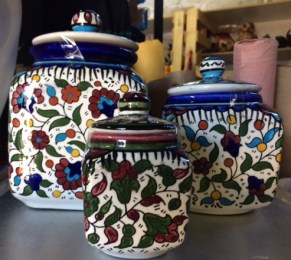
The Palestinian city of Hebron has long been famous for its ceramics and glass-blowing industries.
Traditional Palestinian ceramics are handcrafted ceramics and recognised internationally for their distinctive style and the flower and arabesque patterns, with the intricate details all painted by hand.
Our ceramics are available at The Fair Trade Emporium in the Addison Road Community Centre in Marrickville. This shop is open Fridays 11am -5pm and Saturdays & Sundays 9am-3pm. Watch our Facebook page for sales and markets. As usual, all proceeds go to support our education projects in the city of Hebron and surrounding villages.
Our ceramics are produced at a traditional
family-owned factory in Hebron and our latest
shipment includes g a wide range of colorful hand-painted plates, vases, hanging
ornaments, tiles, cups, mugs and coffee sets.The skills needed to produce these artisanal wares are handed down through the generations.
Hand-painting these unique flower and
arabesque patterns is followed by firing in an open area and charcoal-fuelled kilns.
Ceramics factories in Hebron produce a wide range of products which include household items like wine glasses, dishes, bowls and flower pots as well as tiles and mirrors. There is a wide range of designs with the traditional black and blue floral patterns perhaps the best known while Holy Land motifs and modern designs are also popular.
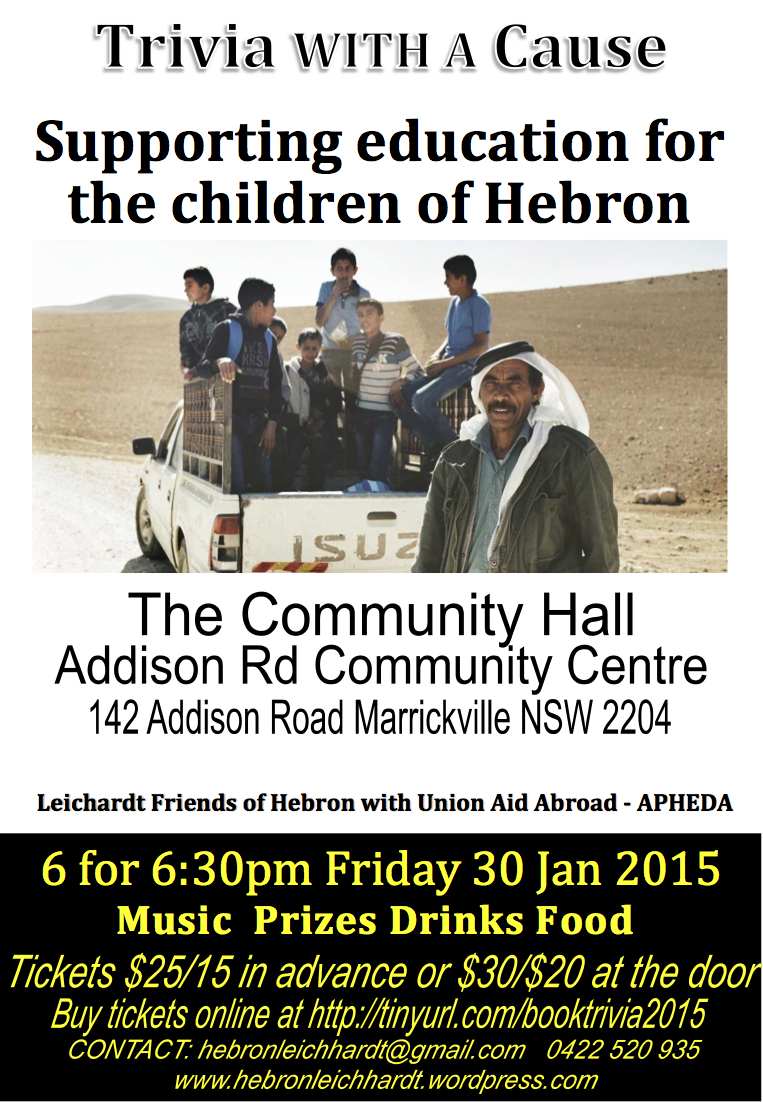
Join us for an evening of fun, facts, delicious food and games – all for a good cause! Help Friends of Hebron pay the wages of three early-childhood teachers working in the Old City of Hebron, as well as the Dkaika education access project .
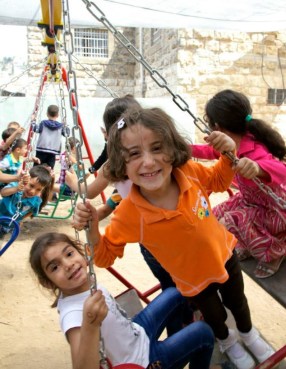
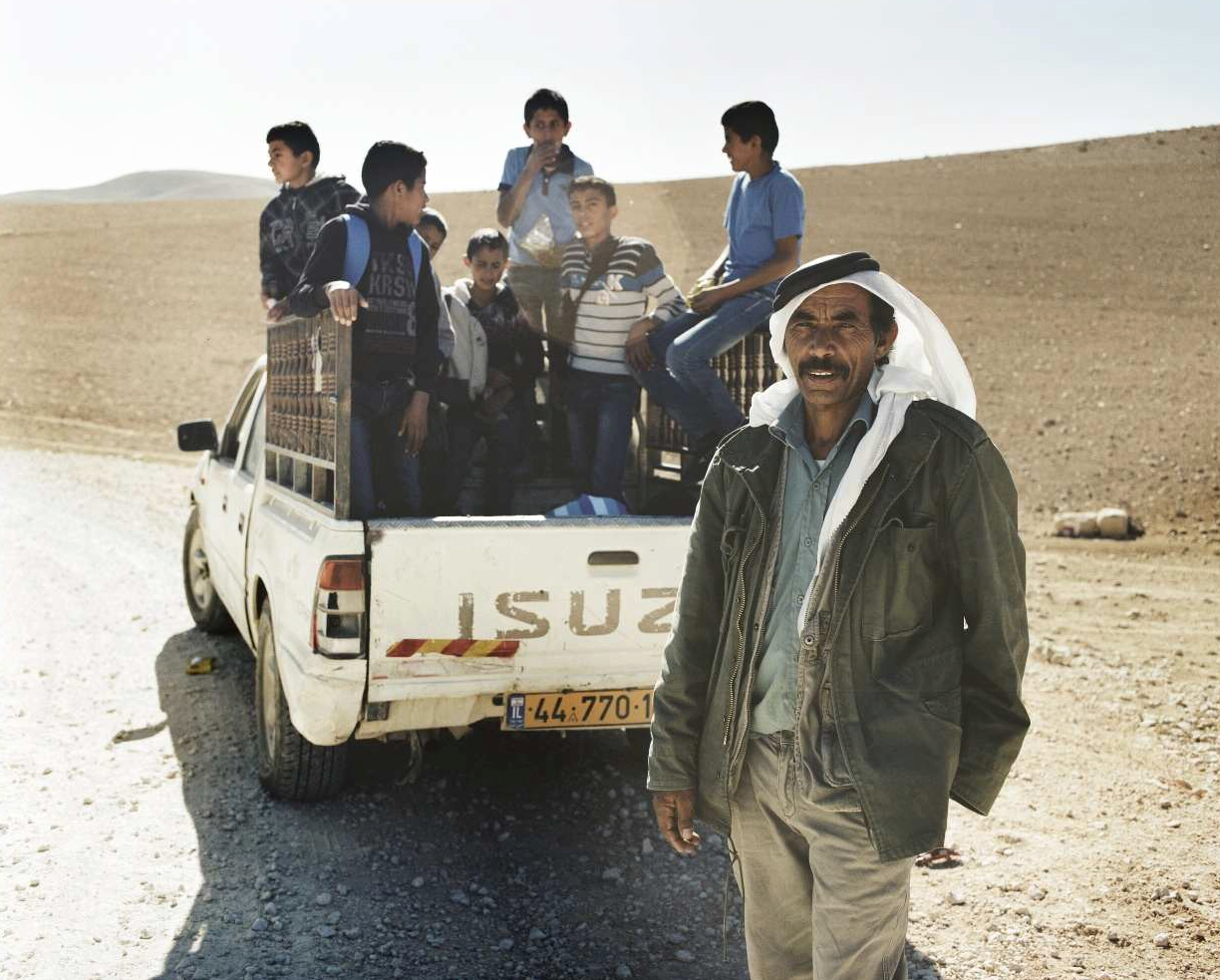
This project provides safe transport for young learners to their closest school (7km away) and for young women to attend university. Photos here.
Help us ensure teachers in the Tel Rumeida kindergarten are paid a living wage (more info about this project here).
“UNRWA teachers, social workers and mental health counsellors across the West Bank are reporting extremely high levels of stress and trauma. If no action is taken an entire generation of children and youth will be lost. Their future must be restored.”
On the occasion of Human Rights Day, the UN Coordinator for Humanitarian Aid and Development Activities, Robert Piper and a group of UN and NGO leaders visited Hebron this week to see first-hand the situation of human rights defenders in Hebron, as well as the obstacles to Palestinian children’s right to an education in a safe environment. During the visit, the delegation spent time in the Israeli-controlled areas of Hebron (H2). The delegation was briefed by organizations providing a ‘protective presence’ for Palestinians. As part of their work, these organizations monitor and document access at checkpoints and accompany children to and from schools in areas where they are subject to frequent settler harassment and violence.
James Heenan of the UN Office of the High Commissioner for Human Rights recalled that human rights defenders have the right to pursue peaceful activities to protect the rights of others, and in turn to be protected in doing so. “The fact that these very people have themselves become a target is alarming,” he said. The visit also took them to Qurtuba school, where protective presence actors accompany some 100 children through check points to and from school every day. At the school, teachers reported that students these days are unable to concentrate and show signs of psychosocial distress and that they are terrified walking through checkpoints to and from school. Felipe Sanchez, Director of UNRWA Operations West Bank, confirmed this, saying “UNRWA teachers, social workers and mental health counsellors across the West Bank are reporting extremely high levels of stress and trauma. If no action is taken an entire generation of children and youth will be lost. Their future must be restored.”
In the current wave of violence, Hebron city has had the highest number of Palestinian casualties in a single locality in the oPt, and increased movement restrictions have affected access to services and places of work throughout the city. Of particular concern is the impact of the violence and the restrictions on the access of children to school due to checkpoints. 4,200 children pass through checkpoints on their way to and from school in Hebron every day. In this context, the reliance on protective presence actors has only become more acute. During this period, obstruction by settlers and Israeli Security Forces of international organizations and local groups attempting to provide a protective presence and documenting human rights violations has also increased. Staff of these organizations have been subjected to physical attacks, arrest, threats by settlers and anonymous death threats. Three of the four organizations providing protective presence have even been obliged to temporarily pull out of H2 at times in October as a result of the threats. Since 3 November, the implementation of a closed military zone in H2 has further prevented these organizations from doing their vital work. “Human rights defenders play a vital role in promoting human rights,” said Mr. Piper after the visit. “Protective presence organizations are on the front line of this work in the occupied Palestinian territory, embodying the support of the world community to the people of Hebron and defending the rights of Palestinian children, not least to a safe journey to and from school. They must be allowed to continue their work without violence, threats or retaliation.”
For more information, please contact Ms. Hayat Abu-Saleh at abusaleh@un.org or +972 54 33 11 816.
As the violence continues on the streets of Occupied East Jerusalem and the West Bank, we need to keep in mind, first and foremost, that what is occurring in the West Bank is not a reaction to an incident that happened a week ago, or two weeks ago. It is the ongoing resistance against the seizure and occupation of lands that started in 1948. The military occupation has been in place since 1967, and this short video is a reminder that the one key message that is consistently omitted from news broadcasts is the fact that Palestinians live under occupation.
The following account from the Christian Peacemaker Team in Hebron gives an account of the trauma and risk that students are facing, and the restrictions on their freedom of movement:
[The following release has been adapted for CPTnet. The original is available on CPT Palestine’swebsite.]
In the first ten days of October, Israeli forces fired more than 143 teargas canisters, as Palestinian children walked to and from school, as well as five stun grenades, from two military checkpoints (approximately 0.3 miles apart) in the H2 section of Hebron. On two of those ten days, Israeli forces also fired rubber-coated steel bullets into a crowd of children (one killed 13 year-old Ahmad Sharaka near Ramallah this week). Two Palestinian children in this area were hospitalised as a result of excessive teargas inhalation on their walk to school on 12.10.15.
In the past week, Israeli forces ambushed and arrested two boys aged 11 and 12 after school on 13.10.15 (see video and full account here). Article 37 of the Convention on the Rights of the Child, states that child arrest is in clear violation of human rights law.
The presence of school children does nothing to deter the Israeli military from this relentless use of teargas, stun grenades, rubber-coated steel bullets, detention and arrest. They are entirely preoccupied with a collection of those children, occupied, harassed and humiliated their entire lives, throwing stones at the heavily armed grown men occupying checkpoints and rooftops.
One Israeli Border Policeman recently told CPTers that the Israeli military supposedly “keeps the children safe”, and that “the little ones can go to the school safely.” Soon after, another Border Policeman fired a steel-coated rubber bullet into a crowd of small boys throwing stones at a soldier on an occupied rooftop who felt so little threat he was wearing no helmet. Meanwhile the day before a total of 81 teargas canisters had been fired in a similar scenario at this checkpoint (Qitoun). See video here.
Such military repression is far from abnormal in H2 Hebron. However, as physical and fatal violence has intensified in these tense first two weeks of October—during which 30 Palestinians have been killed by Israeli forces, 1300 have been injured by live ammunition and rubber-coated steel bullets, with four Israelis killed and 67 injured by Palestinians. Other forms of military repression have also increased, evident in the increased use of physical force and child arrest at school time.
In this context, the little ones, as young as the four-year-olds we walk to kindergarten– cannot walk to school safely as a Border Police man told a CPTer they could. In fact, one of our little friends we walk to kindergarten had to hold his jumper over his nose to avoid the sting of teargas as he left his home on Monday this week. Firing over 143 teargas canisters, five stun grenades, rubber-coated steel bullets and arresting minors is, however, supposedly the Israeli military’s approach to safety when it comes to Palestinian children.
When: 6pm for 6:30 on Tuesday 21 July
Where: The Bush Music Hut
@ Addison Road Centre
142 Addison Rd., Marrickville Map: http://tinyurl.com/o84o2p7
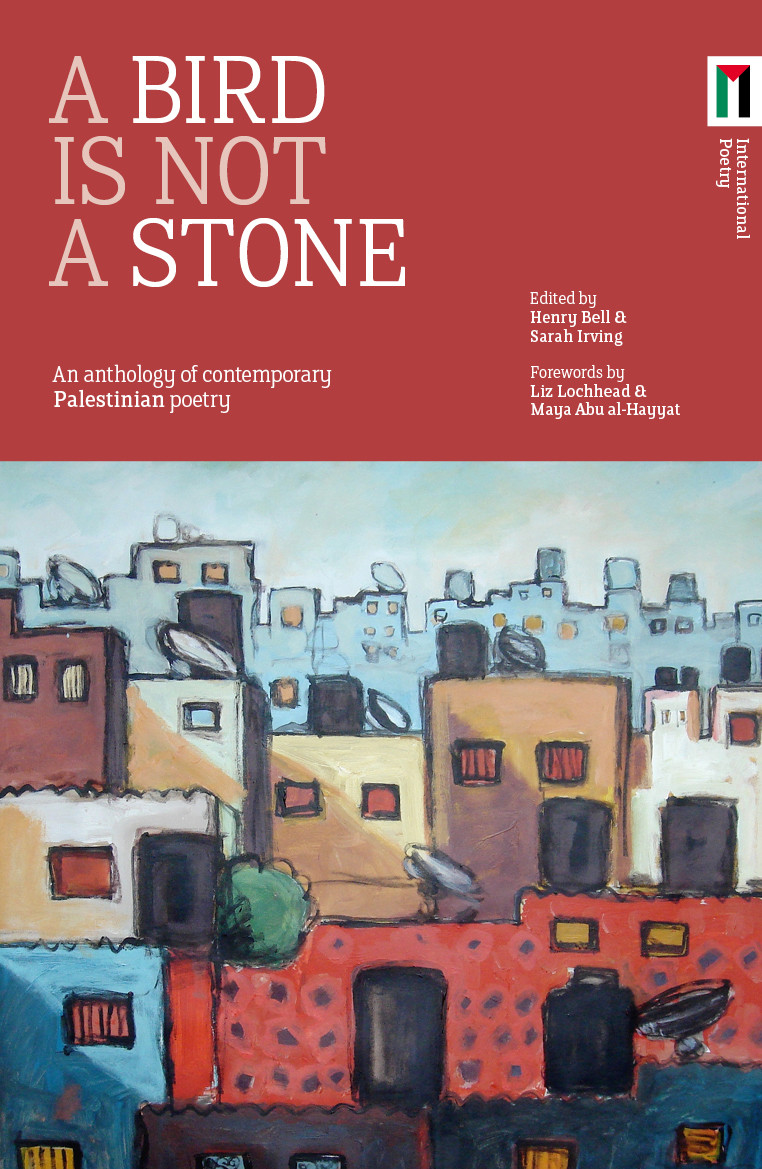
Contemporary Palestinian Poetry – in five languages with introductions by Sarah Irving, editor of “A Bird is not a Stone”, the stunning new anthology of contemporary Palestinian poetry. BOOKING ESSENTIAL:http://www.trybooking.com/IESZ
Tickets $10/$5 and special tickets for our keen supporters who want include a donation to support our education projects in Hebron.
The 25th of February marks the anniversary of the massacre that took place at the Ibrahimi Mosque, in 1994, where 29 Palestinians were shot dead, and another 129 were left wounded. The massacre was committed by a Jewish doctor – an immigrant from the United States and resulted in prolonged curfews, restrictions on movement for Palestinians, the closing of their shops and marketplaces, and a pattern of impunity for settler violence. Since then Israel has continued with its policy of punishing those who are being attacked.
This video was made by the Ecumenical Accompaniment Program in Palestine and Israel, documenting education under occupation through the eyes of some young students and teachers in Hebron.
There is a military watch box on the roof of the Shamsiya house, making the roof a closed military zone and the family is forbidden to access it. For security reasons the Israeli military will search the house on a regular basis. On Saturdays, there is a tour for settlers through Hebron and the settlers from the Tel Rumeida settlement walk past the Shamsiya house. They access the roof and have damaged the water tanks. They throw stones at the family below and their daughter was knocked unconscious after being hit by a rock thrown by a settler. The Israeli military do not stop the settlers from being on the roof. The family are part of the “shoot back” camera project, run by the Israeli Human Rights organisation B’tselem. Vulnerable families are given cameras to document attacks on them and their property.
In the following 9 minute film, Yuval Orrshows what the daily life is like for 15-year-old Awni Abu Shamsiya as he attempts to maintain some shred of normalcy in his hometown of Hebron.
Bookings: http://tinyurl.com/booktrivia2015
Date:Friday January 30, 2015 Time: 6pm for a 6.30pm start Address: Gumbramorra Hall, Addison Road Community Centre, 142 Addison Road Marrickville
Background
Dkaika village
Dkaika has been fighting for its existence with the Israeli government for a decade. It has been demolished, rebuilt and faced yet again with demolition orders. In 2011, they even demolished part of the school.
Since then, UNICEF and Islamic Relief Worldwide have rebuilt and renovated the school, providing a better environment for the students. However it is a primary school only; after Year 6 students must travel at least 7 km for high school.
Driver in Dkaika taking the young boys to school – the girls get to sit inside!For years, the students have walked this distance, over rough mountain tracks, in the heat of summer and through winter snow. Now we are supporting a driver and vehicle, to take those kids to high school.
The aim of this Trivia with a Cause is to raise sufficient funds to ensure the fuel and the driver’s wages are paid until the end of the school year, and if possible, into next year.
Young woman from Dkaika on her way to university,
Now that the school transport scheme is operating, three young women from Dkaika village are able to take up their university places. After dropping off the high school kids, the driver continues to the nearest university so these young women can continue their studies.
Since the beginning of the school year in August over one hundred tear gas grenades have been used against the children. Tear gas works by irritating mucous membranes in the eyes, nose, mouth and lungs, and causes crying, sneezing, coughing, difficulty breathing, pain in the eyes, and temporary blindness.
2nd October 2014 | International Solidarity Movement | Hebron, Occupied Palestine
“The child are having problems concentrating on their school work due to their emotional state and the stress due to the daily attacks by the occupation forces, which are continuously escalating.” Stated Hebron teacher, Shukri Zaroo, to the International Solidarity Movement (ISM).
Children in al-Khalil (Hebron) are forced to pass through a military checkpoint each morning and afternoon in order to reach and leave their schools. International activists try to monitor these military checkpoints, both to document the events and to stand with the children.
ISM activists monitor the Salaymeh checkpoint (29) each school day morning and afternoon. Since school began on August 24th, this is what the ISM activists have witnessed:
August 25th: Israeli forces fired 15 tear gas grenades and canisters, as well as five stun grenades at children as they waited to go to school. Tear gas drifted into the courtyard and many children and teachers choked and spluttered in the playground. School was delayed for over an hour. At one point a Red Crescent ambulance had to be called as two teachers and two children, aged 10 and 12-years-old, required medical treatment for excessive tear gas inhalation.
For the full story of what has been going on in Hebron at the start of the school year, click here.
This video shows the children in the midst of being fired upon with tear gas by soldiers.
From Rabbis for Human Rights and Operation Dove – this article about the ongoing and systematic destruction of houses and structures in Area C of the West Bank – 38 persons lost their homes, including 21 children. The continuous displacement and loss of land and livelihood occurs on a daily basis in the West Bank, and as the Gaza massacre starts to fade from the media cycle, the opportunity to seize a thousand acres of land near Bethlehem is taken for expansion of settlements.
The following update on demolitions in Khirbet ar-Rahma comes Operation Dove, an Italian NGO that focuses on the South Hebron Hills. Khirbet ar-Rahma is a small and poor Palestinian village in Area C of the occupied territories. Since its location in Area C means it is under full Israeli control, the villagers are subjected to the Israeli military planning system that blocks almost every Palestinian attempt at building and developing within their village. Whatever is built, is demolished every now and again, as demonstrated by this most recent demolition. In the background of thephotos, please note the new Jewish settlement, some of which is illegal by the Israeli law, but nevertheless is permitted to stay intact. This is an example of institutionalized discrimination, and demonstrates why RHR submitted an appeal to the High Court of Justice to return planning authority to the Palestinians in Area C.
From Operation Dove:
UPDATE 2014-09-01: IDF DEMOLISHED 9 STRUCTURE IN THE VILLAGE OF KHIRBET AR-RAHWA
38 persons lost their home, 21 of them children
Khirbet ar Rahwa – On 1st of September 2014, during the afternoon, the Israeli army and the D.C.O. (District Coordination Office) entered into the palestinian village of Khirbet ar-Rahwa, in the South Hebron Hills, and demolished 3 houses (tents), 3 animal shelters and 3 toilettes. No demolition order was delivered for these structures.
All the demolished structures were built with simple materials. Ar-Rawha that is located in area C, has no access to electricity, to the water pipeline and to any kind of facilities and services.
The houses belonged to the Altal family and to the Jabaarin family. Because of the demolitions, 38 persons, 21 of them children, lost their houses. All the families are waiting for humanitarian aid.
The village of ar-Rahwa is surrounded by the settlement of Tene and the outpost of Havat Moor. This outpost received demolition order in 2000, but the D.C.O decided to not demolish any house until now. Also the outpost is connected with the electricity net and water pipelines, services that are denied for the Palestinians of ar-Rawha, who are the legal owners of the land where the settlement of Tene is located.

 The Palestinian city of Hebron has long been famous for its ceramics and glass-blowing industries.
 Community Centre in Marrickville. This shop is open Fridays 11am -5pm and Saturdays & Sundays 9am-3pm. Watch our Facebook page for sales and markets. As usual, all proceeds go to support our education projects in the city of Hebron and surrounding villages.





 friendsofhebronsydney.org.au